
You would not bolt a roof rack to your 4WD without checking the torque. You would not top up your coolant with tap water and call it done. Yet when it comes to tyre fitting in Karratha, plenty of people hand over the keys, get a call an hour later, and never think twice about what actually happened in between. Fair enough. You are busy, the ute needs to be back on the road, and tyres are tyres, right?
Not exactly. A proper fitting is a sequence of measured steps that directly affect how your vehicle handles, how long the rubber lasts, and how safely you can stop. Out here in the Pilbara, where your morning commute might cross corrugated gravel and your afternoon run hits 110 on the highway, every one of those steps counts double. Here is what should happen when your tyres are fitted, and why cutting corners costs you more in the long run.
The parts of a tyre fitting that most people never see
When you bring your vehicle into a workshop for tyre fitting, balancing and puncture repair, the visible part of the job takes a few minutes. The parts you do not see are where the quality shows up.
A thorough fitting includes:
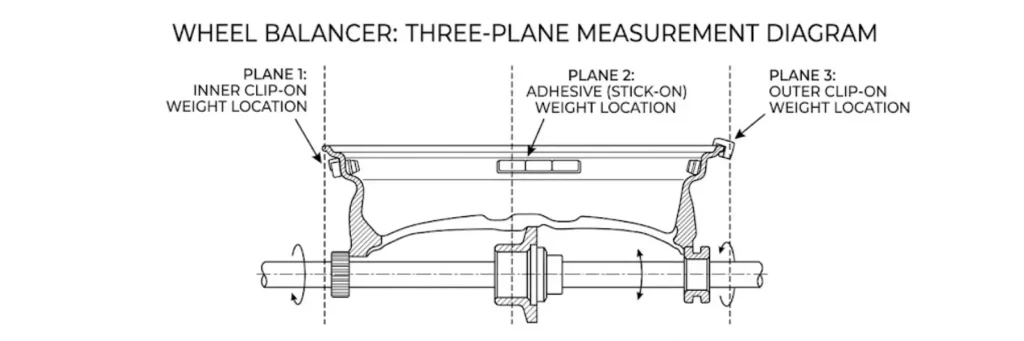
- Wheel balancing on every new tyre. Even brand-new tyres are not perfectly uniform in weight distribution. Without balancing, you will feel vibration through the steering wheel at speed, and the tread will wear unevenly, shortening the life of the tyre.
- Wheel nuts torqued to the manufacturer’s specification. Over-tightening can warp brake rotors and damage wheel studs. Under-tightening is a safety hazard. A calibrated torque wrench is non-negotiable.
- Valve replacement. Rubber valve stems age, crack and leak over time. Replacing them during a fitting is cheap insurance against a slow leak that leaves you on the side of the highway.
- TPMS re-learn (where applicable). Most newer vehicles are equipped with a tyre pressure monitoring system. When tyres are swapped or rotated, the sensors need to be re-learned to the vehicle’s computer so the dashboard reads pressures accurately. Skip this step and you may get false warnings or, worse, no warning at all when pressure drops.
- Tyre pressure set to the vehicle’s specification. Not the number stamped on the tyre sidewall. The correct cold inflation pressure for your vehicle is listed on the placard, usually on the driver’s door jamb, and it differs depending on load.
A fitting that skips any of these steps is not really a fitting. It is just a tyre change.
Why a 4WD tyre fitting is not a sedan fitting
This is where Pilbara driving conditions really come into the picture. Fitting tyres to a HiLux, Ranger, LandCruiser or Prado that does real work in the region is a different job from fitting a set of passenger tyres to a hatchback.
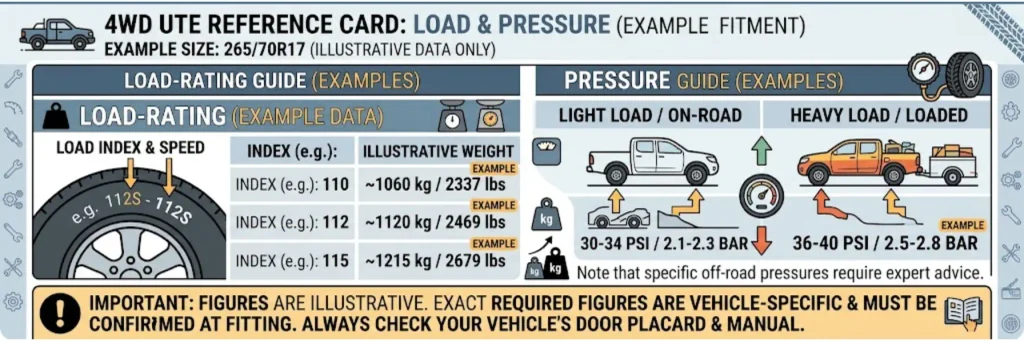
Load rating matters. A loaded work ute heading out to a mine site access road near Dampier or along the North West Coastal Highway can easily sit at or above a tonne on the rear axle. The tyre’s load index needs to match the actual weight the vehicle carries, not just the weight of the vehicle itself. Fitting a tyre with an inadequate load rating is a blowout risk, particularly in the heat.
Pressure needs to match the job. A 4WD running 38 psi on a smooth urban commute may need 32 psi on corrugated gravel and as low as 22 psi on soft sand. A good fitter will talk to you about how you use the vehicle and set pressures accordingly, or at minimum, make sure you understand the range for different conditions. This conversation is part of the service.
Tyre choice is not one-size-fits-all. An all-terrain tyre that works well for a weekend fisher running between Karratha and Point Samson will not necessarily suit a vehicle doing daily runs on site roads carrying heavy loads. Route 1 Mechanical carries a range of quality brands, so there are options to match your driving pattern and budget. Ask the team what suits your vehicle and the conditions you drive in.
According to the WA Road Safety Commission, the Pilbara recorded 33 fatal crashes and 139 serious injury crashes between 2019 and 2023 (Pilbara KSI Crashes 2019-2023, WA Government, August 2024). With single-vehicle run-off-road incidents making up a significant share of those numbers, tyres that are correctly fitted, properly rated and set to the right pressure are one of the most straightforward things you can control.
What to check on the old tyre before it goes back on or off the road
A responsible fitter does not just pull the old tyre off and toss it aside. The outgoing tyre tells a story about the vehicle.
Before discarding or rotating the old tyre, the following should be checked:
- Tread depth. The legal minimum in Australia is 1.5 mm, but for regional and off-road use, replacing well before that point is wise.
- Wear pattern. Uneven wear across the tread signals alignment or suspension issues. Excessive inner or outer edge wear typically points to camber problems, while feathered wear suggests a toe issue.
- Sidewall condition. Cuts, bulges or cracking in the sidewall mean the tyre is compromised. A sidewall failure at speed on a remote highway can be catastrophic.
- Age. Even with decent tread remaining, tyres older than five to six years in a hot climate like the Pilbara should be assessed carefully. Heat accelerates rubber degradation.
If the wear pattern on your old tyres suggests something is off with steering or suspension, that is the time to have a conversation with your mechanic. Route 1 Mechanical offers steering and suspension services and can investigate further before the new tyres go on.
The difference between a fitting and a wheel alignment, and when you need both
This is one of the most common points of confusion, and it comes up regularly in Karratha.
A tyre fitting is the physical process of mounting a tyre to a wheel, balancing it, and installing it on the vehicle.
A wheel alignment adjusts the angles of your wheels (camber, caster and toe) so they sit at the manufacturer’s specified geometry. It involves different equipment entirely and addresses how the wheels track relative to each other and the road.
They are related but separate services. You can have one without the other, but in many cases, you should have both at the same time.
When to get an alignment with your new tyres:
- You are fitting a full set or replacing tyres on the same axle.
- The old tyres showed uneven wear.
- The vehicle pulls to one side or the steering wheel is not centred.
- You have recently hit a deep pothole or kerb, or regularly drive on rough unsealed roads (common in the Pilbara).
- You have had any suspension work done.
Getting an alignment at the time of fitting protects your investment. New tyres on misaligned wheels will wear unevenly from day one, and you will be back sooner than you should be.
Keeping up with your logbook servicing schedule is another way to catch alignment and tyre issues early, before they become expensive.
FAQs
How long does a tyre fitting take?
For a standard set of four passenger or 4WD tyres, including balancing, TPMS re-learn and pressure setting, allow around 45 minutes to an hour. Larger or heavier tyres may take a little longer.
Should I always get a wheel alignment with new tyres?
It is strongly recommended, especially if you drive on unsealed roads or the old tyres showed uneven wear. An alignment protects the new set and ensures predictable handling.
Why is balancing always included in a proper fitting?
Because an unbalanced tyre causes vibration, uneven tread wear and additional stress on suspension components. Balancing is not optional; it is part of doing the job correctly.
Does my vehicle have TPMS?
Most newer vehicles sold in Australia include TPMS. If your dashboard has a tyre pressure warning light (it looks like an exclamation mark inside a horseshoe shape), your vehicle has the system. Your fitter should re-learn the sensors whenever tyres are removed and refitted.
Can Route 1 Mechanical fit tyres for caravans and trailers?
Yes. Route 1 handles a range of vehicles and equipment including caravans, trailers and fleet vehicles through their other services. Book a quote before your next trip.
Where can I get my tyres fitted in Karratha?
Route 1 Mechanical is located at 3/1010 Coolawanyah Road in the Karratha Industrial Estate. As a locally owned workshop, the team fits and balances tyres for sedans, 4WDs, work utes, caravans and fleet vehicles, with a focus on getting the details right for Pilbara conditions.